
Quick Answer: Opening an independent pharmacy from scratch in 2026 requires an initial investment of $400,000 to $800,000. A more realistic budget approaches $850,000 when including sufficient working capital.
Context: As PBM reimbursements tighten and operational complexities grow in 2026, undercapitalization is the primary reason new pharmacies fail. A detailed, line-item budget is more critical than ever. This helps secure financing and ensures long-term viability.
Key Takeaway: This guide provides a detailed, line-item budget analysis. It covers the three main paths to ownership: starting new, buying an existing pharmacy, or franchising. The analysis is based on current industry data and financial modeling.
Key Takeaways
- Total Startup Cost: The average cost to launch a new, independent pharmacy ranges from $400,000 to $800,000. Acquiring an existing pharmacy can cost between $350,000 and $1.2 million or more.
- Working Capital is Critical: A significant portion of the budget must be reserved as working capital. This typically costs $150,000 to $250,000. It covers expenses during the initial 3-6 months before insurance reimbursements create positive cash flow.
- Major Expense Categories: The largest one-time costs are the initial pharmacy inventory ($100k-$150k) and the physical build-out and fixtures ($80k-$200k).
- Ownership Paths: Aspiring owners must choose between starting from scratch (full control, high risk), buying an existing store (immediate cash flow, high valuation), or franchising (brand support, less autonomy).
- Financing Requirements: Lenders typically require a personal cash injection of 10-20% of the total loan amount. Securing 100% financing is extremely rare.
Executive Summary: Key Pharmacy Startup Costs (2026 Data)
This section provides a concise, data-rich summary. It clarifies the core financial components of opening a pharmacy. Understanding these figures is the first step in building a viable business plan.
Definition: The total cost to open a pharmacy is the sum of all one-time capital expenditures (CapEx) required to launch. It also includes the initial working capital needed to sustain operations for the first 6-12 months until cash flow becomes positive.
- Key Statistics:
- Average Total Cost (New Build): $650,000
- Average Acquisition Cost (Existing): $700,000 (plus inventory)
- Initial Inventory: $100,000 – $150,000 (20-25% of total cost)
- Required Working Capital: $150,000 – $250,000
- Franchise Initial Investment: $200,000 – $500,000+
Detailed Pharmacy Startup Cost Breakdown: 15 Essential Line Items
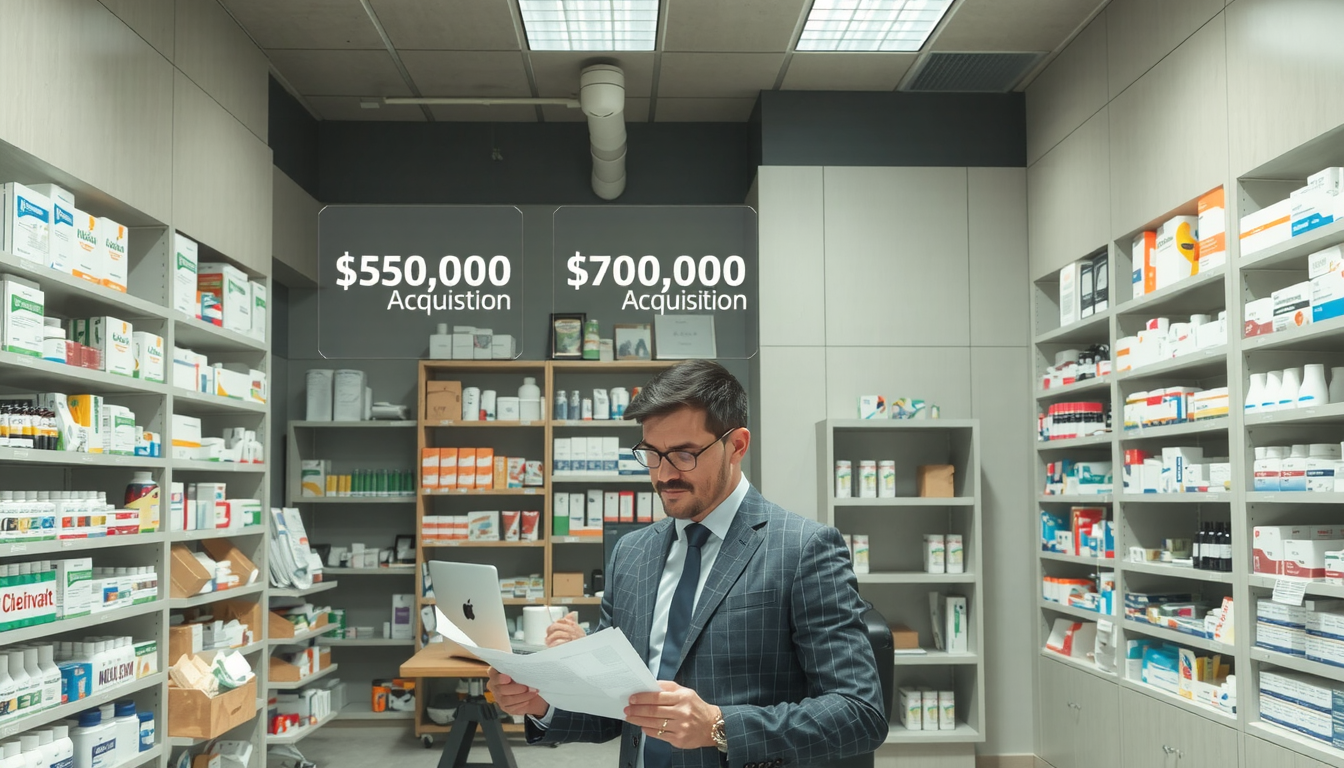
To create an accurate budget, you must move beyond broad estimates. You need to analyze each specific line item. These costs are divided into one-time Capital Expenditures (CapEx) and the initial Operating/Working Capital needed to survive the launch phase. Data from sources like RxMile suggest a typical setup cost between $500,000 and $800,000. Our itemized list shows how that total is allocated.
Capital Expenditures (One-Time Costs)
These are the upfront investments in physical assets and services needed to get your doors open.
- Initial Inventory ($100,000 – $150,000 | 20-25%): This is your single largest initial purchase. It covers the essential brand-name drugs, generics, and over-the-counter (OTC) products required for opening day. Primary wholesalers offer initial stocking plans. However, this remains a major cash outlay.
- Pharmacy Build-Out & Fixtures ($80,000 – $200,000 | 15-25%): This cost varies dramatically. It includes construction, electrical, plumbing, flooring, and the installation of professional shelving, dispensing counters, and private consultation rooms. Engaging a professional pharmacy design company early in the process is crucial. This helps optimize workflow and stay on budget.
- Pharmacy Technology & Software ($25,000 – $50,000 | 5-7%): This is the nerve center of your operation. It includes the Pharmacy Management System (PMS), a Point-of-Sale (POS) system, computers for staff, prescription label and document printers, and a multi-line phone system.
- Specialized Equipment ($15,000 – $40,000 | 3-5%): This category covers essential pharmacy hardware. Key items include automated pill counters, compounding equipment (if offering this service), pharmaceutical-grade refrigerators and freezers, and a robust security and surveillance system.
- Licensing & Legal Fees ($10,000 – $25,000 | 2-3%): Navigating the regulatory landscape requires professional help. These fees cover your State Board of Pharmacy license, DEA registration, National Provider Identifier (NPI) number, and legal counsel for business incorporation (LLC, S-Corp).
- PBM & Insurance Credentialing ($5,000 – $15,000 | 1-2%): This is a critical and often overlooked startup cost. You must be credentialed with major Pharmacy Benefit Managers (PBMs) and insurance plans to be able to accept prescriptions. The process is complex and time-consuming. Many owners hire consultants to manage it.
- Signage & Marketing Launch ($10,000 – $30,000 | 2-4%): To attract customers, you need visibility. This budget covers professional exterior and interior signage, website development, and the initial marketing campaign for your grand opening.
Initial Operating & Working Capital (First 6-12 Months)
This is the cash you need on hand to pay the bills before your revenue stream is stable.
- Working Capital Reserve ($150,000 – $250,000 | 25-30%): [CRITICAL] This is the most common point of failure for new pharmacies. It is the cash buffer needed to cover all expenses while waiting for PBM reimbursements, which can take 30-90 days or more. Revenue does not equal immediate cash flow in the pharmacy business.
- Rent & Utilities Deposit ($10,000 – $25,000 | 2-3%): Landlords typically require a security deposit equivalent to 2-3 months’ rent upfront before you can begin your build-out.
- Initial Payroll ($50,000 – $100,000 | 10-15%): You will need to hire and pay your pharmacist-in-charge, technicians, and clerks for several weeks or months before you open and while revenue is low.
- Business Insurance ($5,000 – $15,000 | 1-2%): This covers the down payment or initial premium for essential policies. These include professional liability (malpractice), general liability, property insurance, and workers’ compensation.
Decision Point: Start New, Buy, or Franchise?
The path you choose to ownership dramatically impacts your total cost, risk profile, and operational reality. Each model has distinct advantages and disadvantages. These must be weighed against your personal goals and financial situation.
| Feature | Start from Scratch | Buy an Existing Pharmacy | Open a Franchise |
|---|---|---|---|
| Total Estimated Cost | $400k – $800k | $350k – $1.2M+ | $200k – $500k+ |
| Key Advantage | Full control over brand, location, and services. | Immediate cash flow, existing patient files & staff. | Proven business model, brand recognition, marketing support. |
| Biggest Challenge | Building a patient base from zero; long ramp to profitability. | High valuation; inheriting potential hidden liabilities. | Franchise fees, royalties, less autonomy. |
| Working Capital Need | Highest (6-12 months) | Lower (1-3 months) | Moderate (3-6 months) |
| Best For: | Experienced pharmacist in an underserved area. | Buyer wanting to skip the startup phase. | First-time owner wanting a structured support system. |
Pharmacy Funding Pathway
Securing financing is a major step. This decision tree helps you determine which path is most viable. It’s based on your current financial standing and business goals.
Start Here: Assess Your Liquid Capital
-
Question 1: Do you have at least $50,000 – $100,000 in personal liquid capital for a down payment (approx. 10% of the loan)?
- No: -> Result: Your primary goal should be to build personal credit and savings. Explore pharmacist manager roles to gain experience while saving capital. Your ownership path is not yet viable.
- Yes: -> Proceed to Question 2.
-
Question 2: What is your primary goal?
- A) Immediate Cash Flow & Existing Patients: -> Result: Your path is Buying an Existing Pharmacy. Begin searching for pharmacies for sale and engage a specialized broker and CPA.
- B) Total Control & Building a Legacy: -> Result: Your path is Starting from Scratch. Proceed to Question 3.
- C) A Guided Process with Brand Support: -> Result: Your path is Opening a Franchise. Research pharmacy franchise opportunities like Health Mart or Good Neighbor Pharmacy.
-
Question 3 (For Starting from Scratch): Are you in a medically underserved or high-growth area with low competition?
- Yes: -> Result: A new build is highly viable. Start developing a detailed business plan and seek an SBA 7(a) loan.
- No: -> Result: Re-evaluate your location or consider a niche service (e.g., compounding, long-term care) to differentiate. The risk is significantly higher.
The 12-Month Pharmacy Opening Cost Timeline
The full process to Open a Pharmacy can take 1-2 years from initial concept to grand opening. Mapping expenditures to this timeline helps manage cash flow and prevents costly delays. According to PioneerRx, a proper planning period is extensive. This timeline reflects that reality.
-
Months 1-3 (Pre-Funding): The Planning Phase
- Costs: Business Plan Consultant ($2k-$5k), Legal Fees for Incorporation ($1k-$3k).
- Action: Develop a GAAP-compliant business plan. Form an LLC/S-Corp and assemble your expert team (CPA, lawyer, consultant).
-
Months 4-6 (Funding & Location): The Commitment Phase
- Costs: Commercial Real Estate Broker Fees (often paid by landlord), Loan Application Fees, Lease Deposit ($10k-$25k).
- Action: Secure financing from a lender. Sign a lease with a “jump-out clause” contingent on financing. Begin architectural design.
-
Months 7-9 (Build-Out & Licensing): The Build Phase
- Costs: MAJOR OUTLAY: Build-out progress payments ($80k-$200k), Board of Pharmacy/DEA application fees ($1k-$3k), PBM Credentialing fees ($5k-$15k).
- Action: Construction and fixture installation begins. Submit all license and third-party insurance applications. This process can take months.
-
Month 10 (Technology & Staffing): The Setup Phase
- Costs: Pharmacy Software/Hardware purchase ($25k-$50k), Hiring costs, initial payroll begins ($10k+).
- Action: Install and test all technology systems. Interview, hire, and begin training your staff.
-
Month 11 (Inventory & Marketing): The Stocking Phase
- Costs: MAJOR OUTLAY: Initial Inventory order ($100k-$150k), Grand Opening Marketing ($10k-$30k).
- Action: Receive, verify, and stock your entire inventory. Launch “coming soon” and grand opening marketing campaigns to the community.
-
Month 12 (Go-Live): The Opening Phase
- Costs: Final inspection fees, petty cash for the register.
- Action: Pass the final Board of Pharmacy inspection and receive your permit to operate. Open your doors to the public. Begin drawing on your Working Capital Reserve ($150k+) to cover the initial cash flow gap.
Beyond Startup: Understanding Ongoing Operational Costs
While startup costs are a one-time hurdle, your business plan must account for the substantial monthly operational expenses required to run a pharmacy. Underestimating these can be just as damaging as underfunding the startup phase. According to industry standards, the cost of goods sold is by far the largest expense.
- Cost of Goods Sold (COGS): ~65-75% of revenue
- Employee Payroll & Benefits: ~10-15% of revenue
- Rent & Utilities: ~2-4% of revenue
- Technology & Software Fees: ~$1,000 – $3,000/month
- DIR Fees & PBM Recoupments: A variable but significant percentage of revenue that is clawed back by PBMs. This must be factored into cash flow projections as a major ongoing cost.
Frequently Asked Questions (FAQ)
Here are answers to some of the most common questions aspiring pharmacy owners have about the financial side of the venture.
-
How much cash do I personally need to open a pharmacy?
You will typically need 10-20% of the total loan amount as a cash injection or down payment. For a $500,000 total project cost, this means having $50,000 to $100,000 in personal liquid capital available. -
Can I get a loan for 100% of the cost?
It is highly unlikely. Lenders, including the SBA, require the owner to have “skin in the game” to ensure commitment and share the risk. Most financing will cover 80-90% of the total project cost, with the owner covering the rest. -
What is the single biggest hidden cost when opening a pharmacy?
The single biggest underestimated cost is the need for sufficient working capital. New owners often focus on the build-out and inventory but fail to budget for the 3-6 months of negative cash flow while waiting for insurance reimbursements to arrive. -
Is it cheaper to open a pharmacy in a rural area?
Yes, generally. Real estate and construction costs can be 30-50% lower in rural or LCOL (low cost of living) areas compared to major metropolitan centers. However, you must also project whether the revenue potential in that area justifies the investment. -
How much more does it cost to add a compounding lab?
Adding a non-sterile compounding lab can add $20,000 to $50,000 in startup costs for specialized equipment (like powder containment hoods), ventilation, and certification. A sterile compounding lab is a much larger investment, often costing well over $100,000.
Author Box & Methodology
Author: Steven Guo, an industry expert in retail environments and commercial build-outs. His work focuses on helping business owners, including independent pharmacists, optimize their physical space for efficiency, customer experience, and profitability.
Data Methodology: The figures in this guide are synthesized from the 2025/2026 NCPA Digest, data from leading pharmacy accounting firms like Sykes & Company, P.A., analysis of SBA loan data for pharmacy startup cost (NAICS 446110), and proprietary financial models. All figures are updated for 2026 projections to provide the most current and actionable information.






 English
  Arabic