
If you are planning a cosmetic store, upgrading a beauty counter, or rolling out display fixtures across multiple locations, the shelf system cannot be treated as a simple furniture purchase. It affects product visibility, customer flow, tester access, daily replenishment, stock storage, lighting coordination, installation speed, and the overall quality impression of the store. A weak shelf plan creates clutter, dead space, poor product grouping, and avoidable opening delays.
The best cosmetic shelf manufacturers solve those problems before they appear on site. They help buyers organize wall display, gondolas, counters, feature zones, and storage into one practical system. They also reduce risk around materials, packaging, shipping, assembly, and future repeat orders. For store owners, contractors, and chain buyers, this is not just about how the shelf looks in a rendering. It is about whether the finished store works under real trading conditions.
This guide ranks the top 10 cosmetic shelf manufacturers in the world in 2026 from a project and procurement perspective. The focus is on the issues that matter most in real retail: how well a supplier understands beauty merchandising, how reliably it handles production and export, how suitable it is for different store formats, and how well it supports the buyer’s actual pain points from concept to opening.
Key Buyer Scenarios for Cosmetic Shelf Projects
Cosmetic shelf projects usually begin with one of four practical business situations. Understanding those situations makes it much easier to choose the right supplier, because each one comes with a different set of problems to solve.
Opening a New Cosmetic or Skincare Store
A new store usually needs help with space planning, wall display layout, counter placement, storage capacity, and the balance between premium presentation and product density. The main pain point is that many buyers know the store style they want, but not yet the fixture system that will make the space efficient and easy to build. In this case, the best supplier is usually one that can convert a concept into practical shelves, cabinets, and display zones without losing the visual direction.
Upgrading an Existing Store Without Closing for Too Long
For remodel projects, the pain point is rarely design alone. It is time. Buyers need fixtures that can improve presentation, increase usable display area, and modernize the store without causing long shutdowns or chaotic on-site work. This makes modularity, assembly logic, size accuracy, and packaging discipline especially important. A supplier that understands refit projects can save weeks of disruption.
Rolling Out a Repeatable Store Model
Chain buyers and regional operators usually care most about repeatability. They need a fixture family that can be reordered, adjusted slightly for different sites, packed consistently, and installed with minimal confusion. Their biggest pain point is inconsistency: one store looks good, the next one does not, or the installation team struggles because the system was never designed for scale. In these projects, a strong manufacturer is one that thinks in standards as well as custom details.
Building a Beauty Counter or Shop-in-Shop Zone
Department store counters, branded islands, and shop-in-shop projects have tight footprints and high visual pressure. The fixtures need to create impact quickly while handling testers, storage, graphics, and lighting within a limited area. The challenge here is not shelf quantity, but shelf efficiency. Buyers need suppliers that know how to use vertical display, focal points, and controlled product grouping to make a compact space sell harder.
What Buyers Usually Need Solved
Across all of these scenarios, the same problems appear again and again: products look crowded, wall space is wasted, testers are poorly organized, back-stock is missing, shipping damage slows the opening, and the store feels less premium than expected. A good cosmetic shelf supplier should solve those issues with better layout logic, stronger material choices, clearer merchandising structure, and more dependable execution from factory to site.
Why Cosmetic Shelf Is Still a High-Opportunity Category in 2026
Cosmetic shelf demand remains strong because beauty retail is still expanding in multiple directions. Prestige brands want immersive and highly branded interiors. Regional chains want repeatable systems that balance aesthetics with cost control. Independent boutiques need smaller but still premium fixture programs. Fragrance, skincare, makeup, and beauty-accessory retailers all continue to rely on display environments that can communicate quality quickly and clearly.
Beauty Retail Is Visually Driven
Cosmetics are not sold the same way as hardware, groceries, or warehouse goods. Packaging color, shelf rhythm, mirror placement, tester accessibility, lighting, and the overall atmosphere all shape perception. Customers often judge quality before touching the product. That makes the cosmetic shelf a key part of brand communication rather than a background utility item.
Retailers Need More Than Basic Storage
A modern cosmetic shelf system may need open display, hidden storage, graphic branding, LED lighting, lockable drawers, display risers, and coordinated counters. That is why many buyers move away from generic shelving. A fixture that works in a beauty environment has to support both presentation and operations. It must help customers browse while also making restocking, cleaning, and stock control manageable for store staff.
Brands Need Flexible Merchandising
Beauty launches change quickly. New product drops, holiday campaigns, influencer collections, tester updates, and promotional bundles all require fixtures that can adapt. Adjustable shelves, replaceable graphics, modular wall bays, and easy-to-refresh display zones are no longer optional advantages. They are increasingly part of the core value proposition of a shelf manufacturer.
Store Opening Risk Is Expensive
The cost of choosing the wrong shelf manufacturer is not just visual disappointment. Delayed openings, damaged goods, incorrect sizes, poor wiring access, weak packaging, and hard-to-install units all create downstream cost. That is why experienced buyers increasingly prioritize execution quality, not just low quote pricing. In a real retail project, the cheapest factory is often the most expensive decision once problems appear.
How Cosmetic Shelf Buyers Evaluate Manufacturers
1. Can the Supplier Support the Full Store, Not Just One Shelf?
Many buyers visiting OUYEE are not searching for a single isolated fixture. They need wall shelving, gondolas, counters, perfume bays, skincare displays, cashier zones, and supporting cabinets that all feel like one brand system. A supplier that can only handle one fixture type may create fragmentation. The strongest partners help buyers keep materials, proportions, and visual language aligned across the entire store.
2. Do They Understand Beauty Merchandising?
A serious cosmetic shelf manufacturer should be able to discuss more than materials and prices. They should understand eye-level presentation, tester access, shade zoning, hero-product placement, shelf depth, bottle stability, visual hierarchy, and the balance between openness and stock capacity. Beauty fixtures live or die by merchandising intelligence. Without it, even expensive fixtures can feel ordinary.
3. Can They Translate Design Into Production?
Many factories can follow instructions, but fewer can translate a concept into shop drawings, manufacturing details, and installation-ready output. That is especially important for buyers who have mood boards or a design idea but need help converting it into real fixture geometry. A supplier with design-for-manufacturing discipline saves time, reduces mistakes, and makes later scaling easier.
4. Are Materials and Finishes Controlled Well?
Cosmetic stores often combine painted wood, laminate, veneer, powder-coated metal, acrylic, glass, stainless steel, and LED lighting in one environment. If the supplier cannot manage finish consistency and tolerance across those materials, the result quickly looks cheap. Buyers should ask how the factory controls color, gloss, edge quality, hardware fit, lighting access, and protection during shipping.
5. Can They Handle Shipping, Packaging, and Installation Logic?
International fixture projects fail surprisingly often at the packaging and installation stage. A shelf can look excellent in the factory and still become a problem if it arrives scratched, mislabeled, over-assembled, or impossible to move into site conditions. Buyers need a partner that thinks through assembly sequence, flat-pack strategy where appropriate, hardware organization, and replacement-part support.
6. Can the System Scale for Future Stores?
For growth-minded brands and chains, the first store is only the beginning. The right supplier should be able to support future replication without redesigning the entire fixture family every time. That means standardizing what should be standard, customizing what really needs brand distinction, and documenting the system well enough to support later rollouts.
The 10 Best Cosmetic Shelf Manufacturers in the World 2026
The companies below are listed from the perspective of buyers comparing cosmetic shelf suppliers for real retail projects. The evaluation is based on publicly visible positioning, product range, store-fixture relevance, and how each company appears to support common project needs such as custom display development, shelf-system planning, rollout execution, and branded retail presentation.
1. OUYEE Display
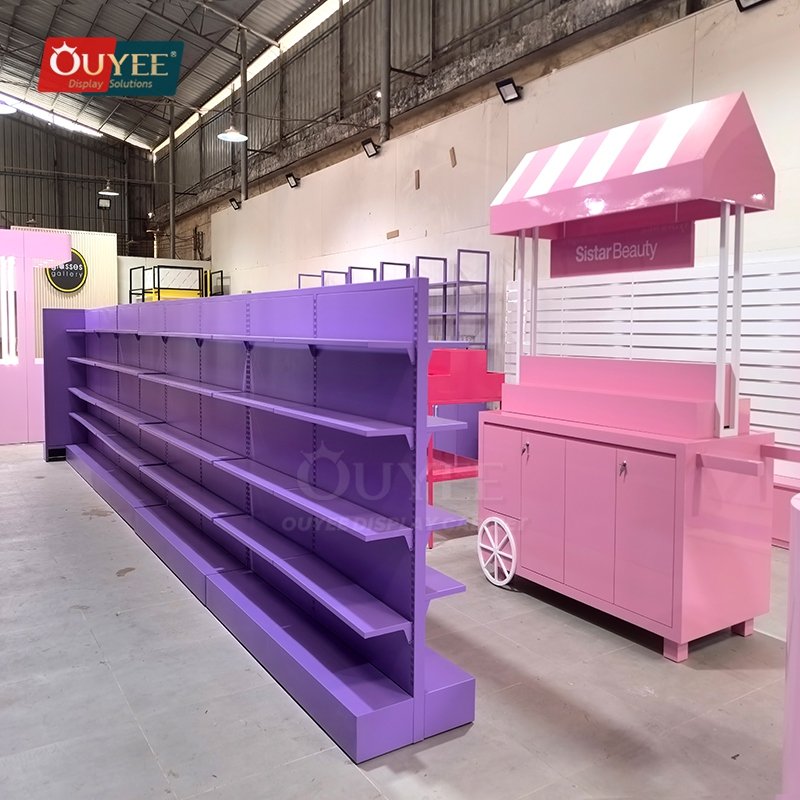
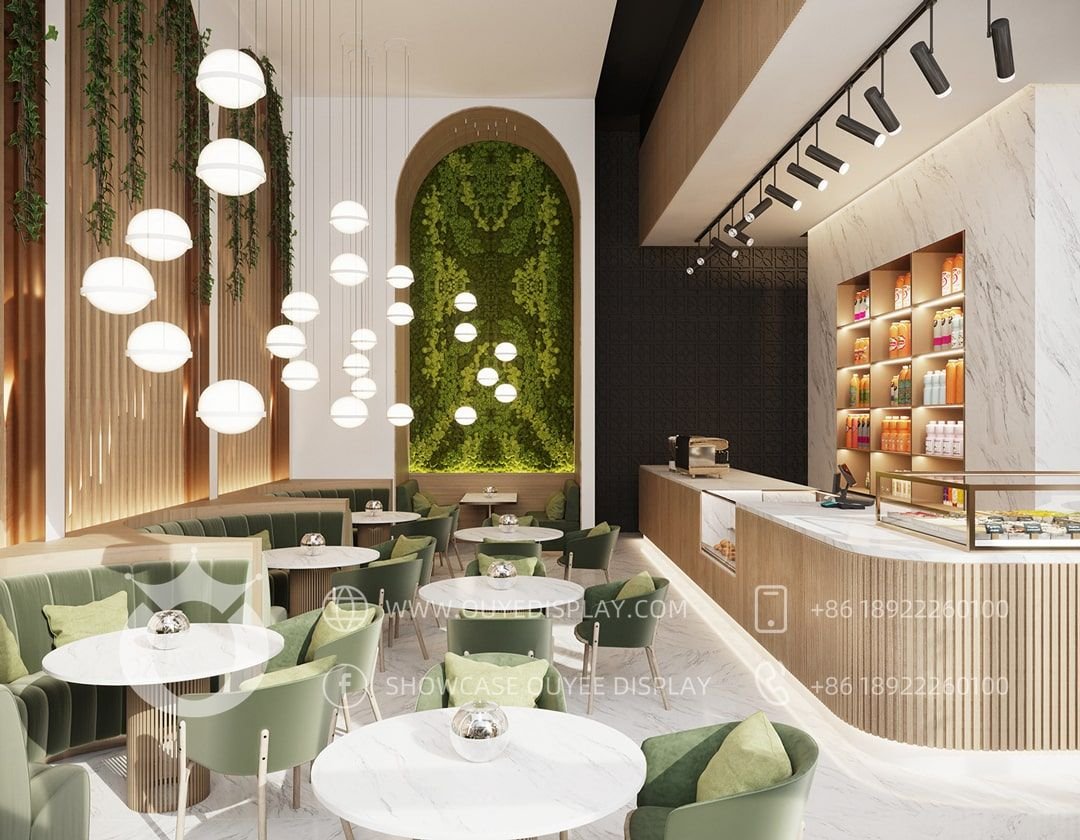
OUYEE Display focuses on custom retail fixtures and store-display solutions, including cosmetic shelves, display cabinets, counters, perfume presentation, and broader beauty-store fixture packages. For buyers, the practical value is that shelving can be developed as part of a coordinated store system rather than as a standalone item. This is useful when a project needs wall shelving, central fixtures, cashier counters, and supporting display zones to work together in one consistent style.
On OUYEE’s site, this can be seen through the connection between Cosmetic Shelf, cosmetic shop fixture packages, custom display cabinets, and Perfume Display. For customers, that means one supplier can potentially support layout development, display coordination, material selection, production, packing, and shipment planning in a more integrated way.
OUYEE is especially relevant for buyers who need customization, design support, and export-oriented project handling. Common customer benefits include help with matching fixtures to store size, combining open display with storage, aligning shelves with brand presentation, and reducing vendor fragmentation across a project. For store owners, contractors, and importers, the main reason to consider OUYEE is the ability to source a broader fixture solution from one place instead of managing separate suppliers for shelves, cabinets, and display furniture.
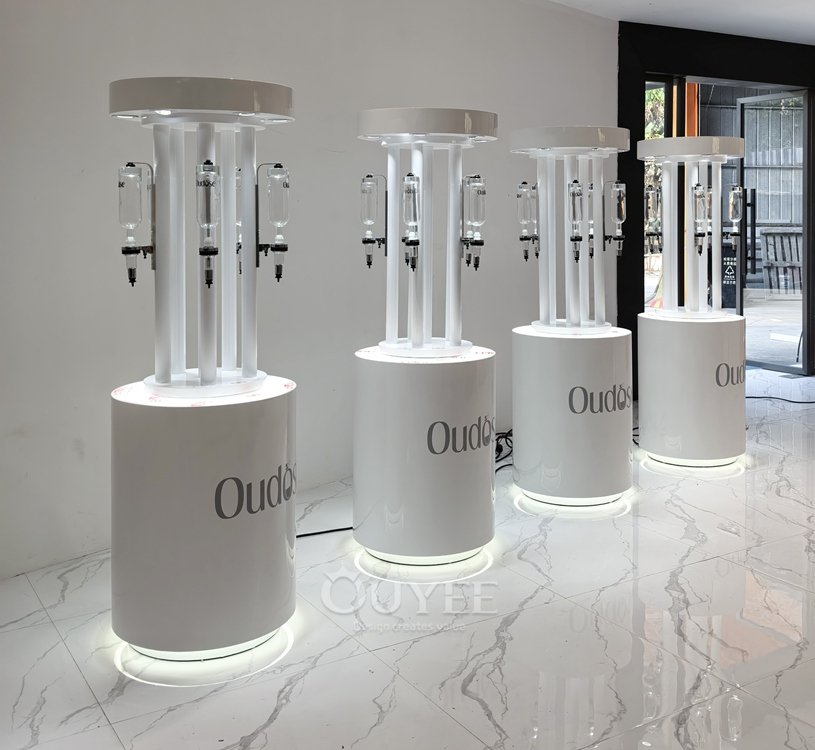
2. ITAB Group
ITAB Group is known internationally for retail interiors, shop concepts, and store-fixture programs. In the context of cosmetic shelf sourcing, its public positioning suggests relevance for buyers who need shelving as part of a broader retail environment rather than only as an isolated display component. This can be useful for established retailers and branded environments where consistency across stores is important.
For customers, a company with ITAB’s profile can be relevant when the project includes multiple fixture types, rollout planning, and coordinated store standards. The main value lies in structured retail delivery, system thinking, and the ability to support commercial spaces where shelving needs to fit into a larger store concept.
Buyers may consider ITAB when they want a partner with a larger international retail-fixture background, especially for chain formats, store refresh programs, and shop-in-shop applications. Its likely advantage is in organized rollout capability and broader retail integration rather than in small-batch custom experimentation.
3. HMY Group
HMY Group is a global shopfitting and retail-solutions company with a strong focus on store environments, commercial fixtures, and project execution. For cosmetic shelf buyers, this type of company can be relevant when shelving is only one part of a larger branded interior project. HMY’s public positioning indicates strength in integrated retail delivery, which can matter for premium beauty spaces, department-store programs, and international retail brands.
From a customer perspective, the practical benefit is that fixture planning can be connected to overall store development, installation, and rollout requirements. This is useful in projects where shelf design has to work together with visual-merchandising areas, service counters, premium display zones, and architectural finishes.
HMY may be most suitable for buyers looking for a structured shopfitting partner with international execution experience. For customers managing larger programs, its value is less about a single shelf type and more about coordinating multiple elements of a retail space under one delivery framework.
4. S-CUBE Retail Fixtures
S-CUBE Retail Fixtures positions itself around design, engineering, prototyping, manufacturing, logistics, and rollout support for custom retail programs. For cosmetic shelf projects, that kind of service model is relevant when the buyer’s main concern is not only display appearance, but also how the fixtures will be managed through production, warehousing, transport, and installation.
For customers, the benefit of this approach is better control over execution details that often become project pain points: lead times, packing, labeling, sequencing, and site-readiness. This can be especially helpful for multi-store programs, department-store updates, and projects where fixture installation must fit into a larger opening schedule.
S-CUBE may be a practical option for buyers who want a more program-oriented partner and place high value on rollout coordination. In cosmetic retail, that can help reduce disruption when shelves and showcases are part of a broader store-improvement project rather than a simple product purchase.
5. Lozier
Lozier is widely known for retail shelving systems and store-fixture infrastructure. Within cosmetic shelf sourcing, it is most relevant to buyers who need dependable modular shelving, repeatable dimensions, and long-term merchandising flexibility. This is especially useful in projects where the store format depends on planogram control, category resets, and repeatable shelf components.
For customers, the main benefit is operational stability. A shelving company with this profile can help when the priority is durable infrastructure, category organization, and consistency across multiple sites. In pharmacy beauty departments, mass retail, and wider chain formats, that can be more important than highly customized decorative detailing.
Buyers may consider Lozier when they need a proven shelving backbone that can later be combined with graphics, lighting, or brand-specific display features. Its value is strongest where repeatability and structure matter as much as visual presentation.
6. Madix
Madix is another established name in retail shelving and display systems, with a profile that fits buyers looking for modularity, accessories, and flexible merchandising layouts. In cosmetic environments, this can be relevant where assortments change frequently and shelf systems need to adapt without requiring a full redesign each time.
For customers, the practical advantage is the ability to manage category changes more easily. Adjustable systems, organized display structure, and support for resets can help stores handle evolving product ranges while keeping the space orderly and sellable.
Madix may be a suitable reference for buyers who need a scalable shelf framework for beauty departments, selective-cosmetics areas, and chain-based merchandising programs. Its main contribution is likely in system flexibility and long-term store maintenance rather than one-off decorative customization.
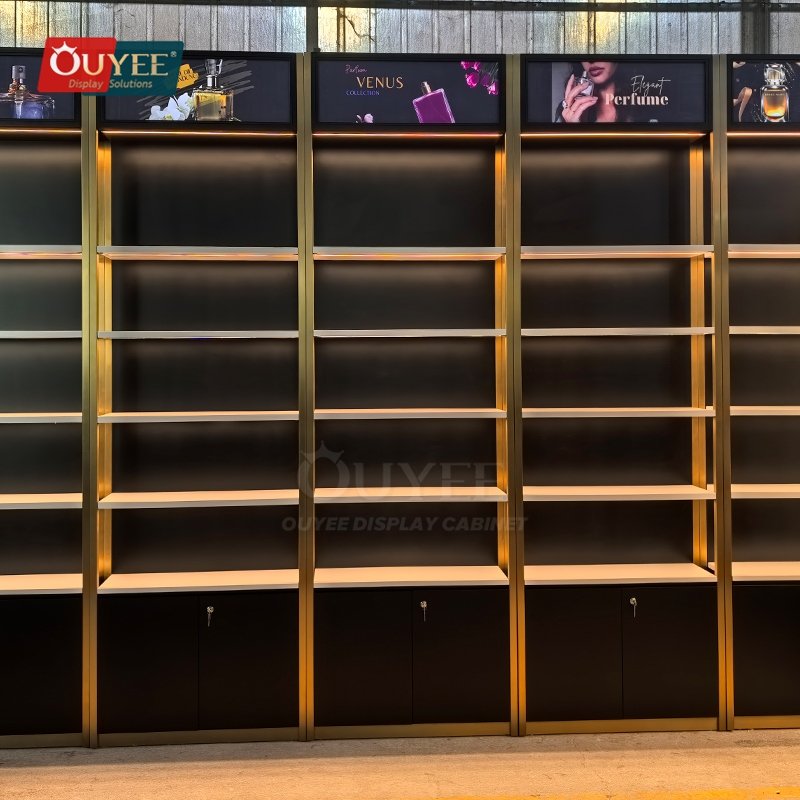
7. Handy Store Fixtures
Handy Store Fixtures is associated with gondola shelving, store design support, and practical retail-fixture programs. For cosmetic shelf buyers, this kind of supplier can be relevant when the store format requires functional merchandising, straightforward category zoning, and dependable shelf infrastructure rather than highly customized luxury shopfitting.
For customers, the benefit is usually speed and practicality. A supplier with this type of offer can help beauty supply stores, independent retailers, and value-driven formats where the key requirement is to create a workable selling floor with clear product organization and durable shelving.
Buyers may look at Handy when opening or refitting stores that need reliable shelf systems with less design complexity. In these situations, the value comes from usability, store planning support, and the ability to move efficiently from layout to installation.
8. Frank Mayer
Frank Mayer is known for custom kiosks, branded displays, and retail fixtures that often sit closer to customer engagement and visual merchandising than to basic shelving alone. In cosmetic retail, this is relevant when the project includes branded counters, compact selling environments, interactive display zones, or feature fixtures designed to attract attention in a limited footprint.
For customers, the benefit is support for display projects where communication and presentation matter as much as storage. This can be useful in department-store counters, promotional beauty spaces, and compact branded retail formats that need a strong visual presence.
Frank Mayer may be considered when a buyer needs more than standard shelves and wants display structures that help strengthen brand visibility, improve space use, or support customer interaction in smaller retail environments.
9. Artitalia Group
Artitalia Group works in custom retail fixtures and commercial environments, including sectors such as beauty and cosmetics. For cosmetic shelf buyers, this type of company can be relevant when the project needs a more customized fixture language, polished finishes, and stronger integration between shelving and the overall brand presentation of the store.
For customers, the value is in tailored retail development. A supplier with this profile may help brands and retailers that want fixture design to reinforce store identity rather than serve only as basic category support. This can be useful in premium counters, branded environments, and stores where materials and presentation play a stronger commercial role.
Artitalia may be a useful reference for buyers seeking custom execution with broader retail-fixture capability. In practical terms, it is most relevant where the shelf system is expected to contribute directly to the visual quality and perceived value of the store.
10. CAEM Group
CAEM Group is associated with modular retail shelving, custom store solutions, and system-based merchandising infrastructure. For cosmetic shelf buyers, this makes it relevant in formats where shelf engineering, layout efficiency, and scalability are central to the project. Its profile suggests value for buyers who need more structure than a purely decorative display supplier typically provides.
For customers, the advantage of this type of supplier is a stronger framework for category organization, repeatable shelf planning, and long-term adaptability. This can be useful in cosmetic chains, perfumery formats, pharmacy beauty departments, and specialty retail where product presentation needs to remain organized as assortments change.
CAEM may be considered by buyers who want a shelving-led solution with custom retail potential. In these projects, the key value is usually the combination of modular planning, structured retail use, and a system approach to display development.
Which Manufacturer Fits Which Type of Buyer?
Best for New Cosmetic Store Owners
If you are opening a new beauty store and want one supplier to support concept development, custom fixture families, and production, the most practical choices are usually OUYEE Display, iYubo, and RTDisplay. These companies are more aligned with buyers who need shelves as part of a complete store solution rather than as isolated hardware.
Best for Rollout and Repeatability
If your priority is scaling across locations, controlling specifications, and reducing future redesign work, S-CUBE, Lozier, Madix, and Handy Store Fixtures become more compelling. These are the types of partners that fit buyers who think in terms of consistency, documentation, and long-term operating efficiency.
Best for Premium Visual Merchandising
If your store concept depends on premium materials, illuminated storytelling, or luxury-level shopper perception, Custom Display Works and HICON deserve more attention. They are particularly relevant for brands that want fixtures to function as brand theater rather than simple category storage.
Best for Buyers Who Need Full-Store Coordination
For buyers who do not want to source shelves, counters, cabinets, and fragrance displays from multiple vendors, a partner with a broader category range is usually the best option. This is where OUYEE’s model is especially strong. On the site, cosmetic shelving is already connected to wider beauty-store and perfume-store display categories, which is exactly how many real projects are purchased.
The Most Important Lesson
The best manufacturer is not the one with the best-looking website or the broadest product catalog. It is the one whose operating model fits your buying scenario. If you choose a system supplier when you need creative custom development, or choose a boutique visual-merchandising partner when you need repeatable rollout discipline, the project becomes harder than it needs to be.
Why Cosmetic Shelf Projects Fail
They Are Designed as Furniture, Not as Retail Tools
A common mistake is treating shelves as furniture only. In reality, cosmetic shelves are selling tools. They must support hero-product emphasis, testing behavior, refilling, store navigation, and product storytelling. When buyers overlook that, they end up with fixtures that may look acceptable but do not perform well in the store.
Buyers Underestimate Installation and Freight
Many expensive problems in fixture projects come from weak packaging, bad part labeling, oversized assemblies, or poor install logic. A shelf manufacturer that ignores these details creates problems for the contractor, the store owner, and the opening schedule. That is why experienced buyers ask detailed questions about freight and assembly long before production begins.
The Supplier Does Not Really Understand Beauty
Some factories are strong in general shelving but weak in beauty presentation. They may not understand tester zones, visual hierarchy, integrated mirrors, shelf depths for specific packaging, or how to combine openness with premium perception. This gap often produces stores that feel functional but not compelling.
The System Cannot Grow
Another frequent mistake is over-customizing everything in the first store without thinking about the second and third locations. If the fixture family has no repeatable structure, scaling becomes expensive and slow. Strong manufacturers help standardize the right parts while keeping the visible brand elements distinctive.
Price Is Given Too Much Weight
Low pricing matters, but in retail fixtures it should never be the only filter. If a lower-cost supplier creates damage, delays, weak finishes, or site confusion, the savings disappear fast. In most serious store projects, the more profitable choice is the supplier that reduces opening risk and future correction cost.
How Different Beauty Retail Formats Need Different Shelf Strategies
Independent Cosmetic Boutiques
Small and mid-size boutiques usually need shelves that do several jobs at once. They need to display products clearly, hold enough stock to reduce constant refilling, and still leave the store feeling open rather than crowded. In these spaces, perimeter wall shelving combined with a few focused hero fixtures is often more effective than filling the floor with too many units. Buyers in this segment usually benefit from a supplier that can simplify the fixture mix while preserving a premium impression.
Beauty Supply Stores With Wider Assortments
Beauty supply stores often carry denser assortments across skincare, cosmetics, accessories, wigs, tools, and impulse items. Their shelf strategy is usually less minimal and more operational. They need stronger category zoning, higher stock support, clearer shopper navigation, and fixtures that can handle broader product variation. In this format, modularity and durability often matter as much as visual luxury.
Perfume and Skincare Hybrid Stores
Stores that combine fragrance with skincare often need a mixed-fixture language. Skincare may live well on open shelves with tester access and routine-based grouping, while fragrance often needs more controlled presentation with glass, lighting, and stronger focal treatment. Buyers in this segment should avoid treating all categories with the same fixture logic. A supplier that can balance shelf systems with showcase-style presentation creates a stronger result.
Department Store Counters and Shop-in-Shop Concepts
For shop-in-shop and department-store beauty areas, the challenge is usually not the total store size but the need to create a strong branded presence inside someone else’s environment. That requires disciplined dimensions, brand-led visual communication, and a controlled mix of open display, back-stock support, and hero focus. In these projects, the cosmetic shelf is part of a larger branded kit of parts, not a standalone furniture decision.
Regional Chains and Franchise Rollouts
Chain and franchise operators need a fixture family that can survive repetition. The first store must look good, but the fifth and fifteenth stores matter even more. That means documentation, stable materials, simplified assembly logic, and the right balance between custom identity and standardized repeatability. Buyers in this category should be especially careful to choose a manufacturer that thinks in systems rather than only in one-off custom builds.
What to Include in Your RFQ to a Cosmetic Shelf Manufacturer
Store Dimensions and Basic Floor Plan
One of the fastest ways to improve supplier communication is to provide a basic floor plan early. Even a rough dimensioned layout helps the manufacturer understand circulation, wall lengths, cashier position, columns, windows, and potential focal zones. Without this information, suppliers often quote too generally and the early design conversation becomes vague.
Product Mix and Merchandising Priorities
Tell the supplier what categories the shelves need to support. Lipstick, skincare bottles, fragrance, gift boxes, and accessories all require different depths, display angles, and storage assumptions. Also explain whether your priority is premium visual presentation, high SKU density, tester accessibility, or fast replenishment. The better the product and merchandising brief, the better the fixture proposal.
Reference Images, Material Direction, and Brand Mood
Most cosmetic shelf projects are easier when the buyer provides a clear visual direction. This can include reference photos, mood boards, preferred colors, material samples, store inspiration, and notes about the brand mood. Is the environment meant to feel luxury, fresh, youthful, clinical, natural, or fashion-driven? These cues influence everything from shelf proportions to finish choices and lighting style.
Budget Range and Delivery Timeline
Many buyers avoid discussing budget at the start, but that often slows the process. A supplier can only recommend the right material strategy and customization depth if it understands the commercial boundary. The same is true for the timeline. If you have a mall opening date, franchise launch, or rollout deadline, say so early. Good factories make better decisions when the business constraints are visible from the beginning.
Destination, Shipping Model, and Installation Expectations
International projects require the manufacturer to think carefully about freight method, packaging, on-site assembly, and damage prevention. Tell the supplier where the goods will ship, whether the project is for one location or several, whether there is a local contractor, and what level of installation guidance is expected. These details affect packaging method, hardware organization, and production decisions much earlier than many buyers realize.
Why OUYEE Display Is a Strong Match for This Audience
OUYEE fits this market well because its site and product structure already align with the real buying journey of cosmetic shelf customers. The reader is not only seeing one shelf item. They are seeing a path from Cosmetic Shelf into related fixture families and broader store solutions. That is important because buyers opening or upgrading a beauty store usually think in projects, not isolated SKUs.
That project logic is visible in product pages such as small cosmetics shop counter solutions, store layout display furniture, and linked categories like Perfume Display. This is the kind of product ecosystem that makes sense to actual buyers planning a store, a rollout, or a branded beauty zone.
OUYEE also positions itself around design, production, logistics, and one-stop execution. For the audience we identified earlier, that is not a side message. It is the main value proposition. Store owners want a smoother path to opening. Buyers want fewer vendor handoffs. Contractors want clearer production logic. Chains want better scalability. Those are the reasons OUYEE deserves to rank at the top of a cosmetic shelf manufacturer guide written for fixture buyers.
Frequently Asked Questions (FAQ)
What is the difference between a cosmetic shelf system and standard retail shelving?
A cosmetic shelf system is designed around visibility, tester access, product zoning, premium presentation, and daily store operations. Standard retail shelving may be structurally useful, but it often lacks the detailing needed for beauty merchandising, branded display, lighting integration, and compact high-value product presentation.
Who should use a cosmetic shelf buying guide like this?
This guide is most useful for beauty-store owners, chain buyers, shopfitters, contractors, designers, and brand teams that need shelving as part of a real retail project. If the goal is to improve store layout, increase display efficiency, upgrade presentation, or prepare for a new opening, these are the buying situations this article is built around.
What makes cosmetic shelves different from normal retail shelves?
Cosmetic shelves usually require more attention to presentation, tester access, material refinement, lighting, graphics, and visual hierarchy. In beauty retail, fixture quality directly affects perceived product value. That is why generic shelving often underperforms in cosmetic environments.
Can one manufacturer handle a full cosmetic store project?
Yes, the strongest suppliers can support wall shelving, counters, gondolas, display cabinets, perfume fixtures, stock-support furniture, and decorative elements within one coordinated package. For many buyers, this is the most efficient approach because it reduces vendor fragmentation and helps maintain a consistent design language.
What should I ask before choosing a supplier?
Ask how the supplier handles design revisions, drawings, materials, finish control, hardware, packaging, shipping, replacement parts, and future repeat orders. Also ask whether they have direct experience in beauty-store projects rather than general shelving alone.
How important is 3D design and shop drawing support?
It is very important, especially if you are building a new store or adapting a concept to a real site. Good drawing support reduces mistakes, improves communication, and makes installation more predictable. For many buyers, strong drawing support is one of the clearest signs of a serious fixture partner.
Should I choose a specialist beauty-fixture supplier or a modular shelving supplier?
That depends on your project. If you want a brand-led, custom, premium environment, a beauty-fixture specialist is often the better choice. If you need scalable, practical, repeatable shelf infrastructure across many stores, a modular shelving supplier may be more suitable. The correct answer depends on your retail model.
How can I reduce risk on my first order?
Start with a clear brief, confirm drawings carefully, review material samples, ask detailed packaging questions, and if possible test the supplier with a pilot project or a smaller program before committing to a broad rollout. Early clarity saves expensive corrections later.
Why do some beautiful fixture concepts fail after delivery?
Because rendering quality and production quality are not the same thing. Many fixture problems appear only after shipping, unpacking, assembly, and real store use. That is why engineering, packaging, and install thinking matter just as much as visual design.
Final Thoughts
The best cosmetic shelf article is one that helps buyers make better project decisions. That means focusing on layout efficiency, display logic, storage, materials, shipping, installation, and repeatability instead of filling space with generic industry talk. When the content stays close to real project problems, it becomes more useful to buyers and more valuable for inquiry generation.
If you are planning a cosmetic store, a beauty retail rollout, or a branded display upgrade, use this manufacturer list as a starting point. Then compare suppliers according to what actually matters for your project: store-fit capability, beauty-merchandising relevance, engineering discipline, logistics readiness, and long-term scalability.



 English
  Arabic