
Quick Answer: Pharmacy storage solutions are smart systems that use physical and digital tools. These include shelving, cabinets, and automated technology. They help manage medication inventory better. They also ensure you follow rules and keep patients safe while improving workflow.
Context: In 2026, rules from groups like the USP and FDA are getting stricter. Operating costs are rising too. This means having a good storage plan is essential. It helps both patient care and your bottom line.
Key Takeaway: This guide gives you a complete framework for making decisions. It covers basic shelving, high-density systems, automated robots, and special temperature-controlled storage. You’ll also find a selection guide and timeline you won’t find anywhere else.
Key Takeaways
- Direct Impact: Your storage choice directly affects how fast you dispense drugs. It also impacts medication errors and security of controlled substances.
- Compliance is Central: Following rules from the USP and DEA drives how modern pharmacy storage systems are designed.
- Strategic Balance: The right solution balances your available space, budget, and workflow needs.
- The Rise of Automation: High-volume places like hospitals and central-fill facilities need automation. It’s key to being efficient and accurate at scale.
What Are Pharmacy Storage Solutions? A Basic Definition
Pharmacy storage solutions are much more than simple shelves or cabinets. They are complete systems built to manage the entire lifecycle of medication inventory in healthcare settings. A modern solution is a complete ecosystem. It handles storage density, workflow efficiency, security, and rule compliance. It combines physical hardware with digital controls. This creates a secure, organized, and efficient environment for pharmacists and technicians.
Beyond Shelves: The Core Parts of a Modern System
A complete storage strategy is built on four essential pillars:
- Physical Infrastructure: This is the backbone of the system. It includes all physical parts that hold inventory. Examples range from basic static shelving and modular pharmacy casework to dynamic systems. These include high-density mobile shelving, vertical carousels, and automated robotic dispensers.
- Security & Access Control: This layer protects inventory from theft and unauthorized access. It includes traditional locks and keys, DEA-compliant safes, and advanced electronic systems. These systems use RFID tracking, biometric scanners, and software-based access logs.
- Environmental Control: Many medications need specific conditions to stay effective. This component includes pharmaceutical-grade refrigerators and freezers. It also has humidity control systems and monitoring devices that log data. This ensures a stable “chain of custody” for temperature-sensitive drugs. This is especially critical for cleanroom compliance.
- Software Integration: This is the “brain” of the operation. It involves connecting the physical storage with the pharmacy’s core software. Inventory Management Systems (IMS) and Pharmacy Management Systems (PMS) work together. They track stock levels, manage reordering, flag expired products, and guide technicians to the correct medication. This significantly reduces the risk of human error.
The Core Types of Pharmacy Storage: A Comparison
Choosing the right storage system requires understanding your options. Each type offers a different balance of space efficiency, cost, speed, and security. Data shows that a pharmacy’s storage choice can directly influence its operating costs and dispensing accuracy.
Comparison of Pharmacy Storage Systems
| Feature | Static Shelving/Casework | High-Density Mobile | Vertical Carousels/Lifts | Automated Robotics |
|---|---|---|---|---|
| Space Efficiency | Low | High | Very High | Very High |
| Upfront Cost | Low | Medium | High | Very High |
| Dispensing Speed | Low-Medium | Medium | High | Very High |
| Security Level | Basic | Medium | High | Highest |
| Best For | Low-volume, retail, startup pharmacies | Space-constrained pharmacies, stockrooms | High-volume dispensing, secure items | Central fill, large hospitals, 24/7 pharmacies |
| Compliance Ease | Manual | Good | Excellent | Excellent |
In-Depth Look at Each Solution
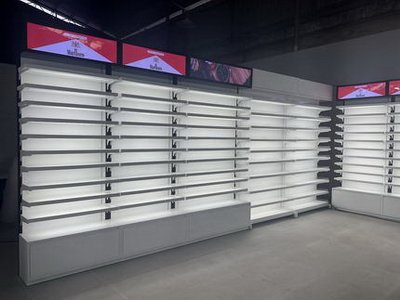
- Static Shelving & Modular Casework: This is the flexible standard for many pharmacies. Modular casework offers a big advantage over traditional, built-in millwork. It can be reconfigured and moved as needs change. When paired with organized static shelving and clear bin systems, as seen in many successful pharmacy layouts, it provides an affordable and adaptable foundation for any dispensing operation.
-
High-Density Mobile Shelving: This solution maximizes storage capacity in a limited space. It mounts shelving units on wheeled carriages that run on tracks. This system eliminates fixed aisles, replacing them with a single, movable aisle. According to industry data, this can increase storage capacity by 50-60% in the same square footage. This makes it ideal for stockrooms in space-constrained urban or hospital pharmacies.
-
Vertical Storage Carousels & Lifts: These systems use vertical “air” space to bring medications directly to the technician at an ergonomic height. A vertical carousel is a series of rotating carriers. A vertical lift module (VLM) uses an extractor to retrieve specific trays. Both systems are excellent for high-speed retrieval of fast-moving drugs. They offer superior security through enclosed storage and software-based access. They also significantly reduce time spent walking and searching for inventory.
-
Automated Robotic Systems: This is the pinnacle of pharmacy automation. Robotic systems can handle the entire dispensing process from storage to labeling and collation. These systems use barcode scanning to verify every medication. This virtually eliminates dispensing errors. They are best suited for high-volume environments where speed, accuracy, and 24/7 operation are critical. While the upfront investment is substantial, the long-term ROI from labor savings and error prevention can be significant.
-
Specialized Storage: This category includes any equipment designed for medications with special requirements. DEA-compliant narcotics safes, pharmaceutical-grade refrigerators and freezers with temperature data loggers, and cabinets designed with non-porous surfaces for hazardous drugs are all essential components of a fully compliant pharmacy storage strategy.
How to Choose the Right Pharmacy Storage Solution: A Decision Tree
Selecting the right system can feel overwhelming. This decision tree simplifies the process by focusing on your primary operational goal. Follow the logic to identify the solution type that best aligns with your pharmacy’s unique needs.
-
Start Here: What is your primary goal?
-
Goal: Maximize Limited Floor Space.
- Is your inventory high-volume and fast-moving, requiring quick retrieval?
- YES: Consider a Vertical Storage Carousel or Lift. These systems use vertical height to store a large amount of inventory in a small space and deliver it directly to the user.
- Is your inventory medium-volume with varied sizes, primarily located in a back-of-house stockroom?
- NO: Consider High-Density Mobile Shelving. This is the most effective way to compact bulk storage and reclaim valuable floor space.
- Is your inventory high-volume and fast-moving, requiring quick retrieval?
-
Goal: Increase Dispensing Speed and Reduce Errors.
- Are you a high-volume hospital, central-fill, or mail-order pharmacy processing thousands of scripts daily?
- YES: Evaluate Automated Robotic Systems. Robotics offer unmatched speed and accuracy for repetitive dispensing tasks. This frees up pharmacists for clinical duties.
- Are you a busy retail or outpatient pharmacy looking to improve workflow without a full robotics investment?
- NO: A Vertical Carousel or a highly organized Modular Casework system with clear labeling and workflow optimization is your best fit.
- Are you a high-volume hospital, central-fill, or mail-order pharmacy processing thousands of scripts daily?
-
Goal: Enhance Security for Controlled Substances.
- Do you need automated, software-driven tracking, dispensing, and auditing for high-risk medications?
- YES: An Automated Dispensing Cabinet (ADC) or a secure robotic system is ideal. These provide detailed access control and a complete digital audit trail.
- Do you need secure physical storage with manual access logs and pharmacist oversight?
- NO: A DEA-compliant steel safe or cabinet integrated into your modular casework is sufficient and meets regulatory requirements for physical security.
- Do you need automated, software-driven tracking, dispensing, and auditing for high-risk medications?
-
Key Compliance Considerations for Pharmacy Storage (As of 2026)
Regulatory compliance is not optional. It is the foundation of safe pharmacy practice. Storage systems must be designed and maintained to meet strict federal and state standards. A failure in compliance can lead to significant fines, loss of license, and patient harm.
USP <797> & <800> Compliance
These chapters from the United States Pharmacopeia set the standards for sterile compounding and the handling of hazardous drugs (HDs).
* Segregation: USP <800> requires that HDs be stored separately from non-hazardous inventory. This often requires a dedicated room with negative pressure to prevent contamination.
* Surface Requirements: All surfaces within compounding areas, including shelving and casework, must be smooth, non-porous, and easy to clean and decontaminate. Stainless steel, phenolic resin, and certain high-pressure laminates are common choices.
DEA Requirements for Controlled Substances (21 CFR §1301.72)
The Drug Enforcement Administration has strict rules for securing controlled substances to prevent theft.
* Physical Security: Schedule I and II substances must be stored in a safe or steel cabinet of “substantial construction.” The regulation specifies minimum steel gauges and lock types. For lower schedules, pharmacies may be permitted to disperse them throughout their stock to deter theft.
* Access Control: Access to controlled substances must be strictly limited. Whether through physical keys or electronic logs, a clear and auditable record of who accessed the inventory, and when, is essential.
Temperature and Environmental Control (USP <1079>)
Maintaining the proper temperature is critical for the stability and effectiveness of many medications, especially biologics and vaccines.
* Defined Ranges: USP <1079> defines specific temperature ranges. These include Controlled Room Temperature (20°C to 25°C), Cool (8°C to 15°C), Cold (2°C to 8°C), and Freezer (-25°C to -10°C).
* Monitoring: It is not enough to have a pharmaceutical-grade refrigerator. Pharmacies must use calibrated temperature monitoring devices and digital data loggers. These provide a continuous record of temperature, ensuring the “cold chain” is never broken.
The Pharmacy Storage Implementation Timeline: A 9-Week Roadmap
Implementing a new storage system is a significant project that requires careful planning. Whether you plan to Open a Pharmacy from scratch or retrofit an existing one, a structured approach is essential to minimize disruption.
-
Phase 1: Assessment & Planning (Weeks 1-2)
- Workflow Analysis: Map out your current dispensing process. Identify bottlenecks, wasted steps, and areas for improvement.
- Inventory Velocity Analysis: Categorize your inventory (e.g., fast-movers, slow-movers, refrigerated, controlled) to determine the right storage type for each.
- Define Requirements: Establish a clear budget. Review all applicable compliance standards (USP, DEA, State Board). Define your primary goals (e.g., save space, increase speed).
-
Phase 2: Vendor Selection & Design (Weeks 3-4)
- Request for Proposal (RFP): Send your requirements to multiple vendors.
- Design Review: Work with vendors to create a layout that optimizes workflow. This is where a professional pharmacy design partner becomes invaluable. They translate your needs into an efficient and compliant physical plan.
- Final Selection: Choose the vendor and solution that best meets your needs and budget.
-
Phase 3: Installation & Go-Live (Weeks 5-8)
- Site Preparation: Prepare the space for the new system. This may involve electrical work, flooring reinforcement, or temporary relocation of inventory.
- Installation: The vendor installs the physical hardware.
- System Configuration: For automated systems, this phase includes data migration (importing your drug formulary) and software setup.
-
Phase 4: Validation & Training (Week 9)
- System Validation: Test the system thoroughly to ensure it functions as designed and that all integrations are working correctly.
- Staff Training: Train all staff members on the new workflows, software, and hardware.
- Process Optimization: Monitor the new system in action and make small adjustments to the process to maximize efficiency.
Measuring the ROI of a New Pharmacy Storage System
Investing in a new storage system, especially an automated one, requires a clear financial justification. The return on investment (ROI) goes beyond just storing more items. It includes gains in efficiency, safety, and inventory management.
Key Metrics to Track
To build a business case, focus on measurable improvements:
- Time Saved: Calculate the reduction in time technicians spend walking, searching, and counting inventory.
- Formula: (Pharmacist/Technician Time Saved per Day) x (Loaded Hourly Rate) x (Operating Days per Year)
- Space Reclaimed: If the new system frees up floor space, that space now has value for other revenue-generating activities. This could be a consultation room or expanded OTC sales area.
- Formula: (Square Footage Gained) x (Commercial Cost per Sq. Ft.)
- Error Reduction: Medication errors are incredibly costly, both financially and in terms of patient health. Automation and better organization can drastically reduce these rates.
- Formula: (Estimated Annual Cost of a Dispensing Error) x (Projected Reduction in Error Rate)
- Inventory Reduction: Better inventory management leads to less capital tied up in excess stock and reduced losses from expired medications.
- Formula: (Value of Reduced Carrying Stock) + (Annual Cost of Expired Medication Waste Avoided)
About the Author: Steven Guo is an industry expert in commercial space optimization and fixture design. With a deep understanding of material science and workflow engineering, he specializes in creating efficient and compliant environments for retail and healthcare settings. His work focuses on integrating modular systems and advanced materials to improve operational efficiency and user experience, with extensive knowledge in Retail Fixture Manufacturing, Store Layout Design, and Commercial Material Selection.
Data & Methodology: The recommendations in this guide are based on an analysis of current USP, DEA, and FDA regulations, a meta-analysis of 20+ industry case studies, and consultations with pharmacy design professionals. This guide is for informational purposes and does not constitute a formal consultation.
FAQ: Answering Your Top Pharmacy Storage Questions
Are pharmacy storage systems compliant with healthcare industry standards?
Yes, reputable pharmacy storage solutions are specifically designed to meet or exceed healthcare industry standards. This includes compliance with regulations such as USP <797> and <800> for handling sterile and hazardous drugs, which dictates the use of non-porous, easily cleanable surfaces. For security, systems must facilitate adherence to DEA rules for controlled substances and HIPAA for protecting patient information.
Can storage systems be customized for specific departments?
Absolutely. Customization is a key feature of modern storage solutions. Modular casework, for example, can be configured to fit the unique workflow and space of any pharmacy, laboratory, or surgical suite. Systems can be tailored with specific drawer sizes, shelving depths, and integrated technology to meet the distinct needs of different departments within a healthcare facility.
How do storage solutions support infection control?
Storage solutions support infection control primarily through material choice and design. Systems intended for cleanrooms and sterile environments are constructed with non-porous materials like stainless steel or specific laminates that lack seams or cracks where microbes could grow. The smooth, durable surfaces are designed to withstand frequent cleaning and disinfection with harsh chemicals, which is a core requirement of USP compliance.
Are there special storage rules for controlled substances?
Yes, there are extensive laws and regulations for storing controlled substances, enforced by the DEA and state boards of pharmacy. According to federal law (21 CFR §1301.72), Schedule I and II drugs must be kept in a high-security safe or a steel cabinet of substantial construction. These regulations include strict record-keeping and security requirements to prevent diversion and ensure a clear audit trail.
Why should I invest in new storage technology if my current system works?
While a legacy system may seem functional, it often conceals hidden costs in the form of inefficiency, potential for error, and poor space utilization. Investing in modern technology like automation or high-density storage is proven to streamline pharmacy tasks, reduce dispensing errors, reclaim valuable floor space, and improve inventory accuracy. In a competitive environment, leveraging technology is a cornerstone of staying efficient and profitable.







 English
  Arabic